I focus a lot on charts — with huge help from the ace Axios visuals team — because energy and AI are complicated topics often told best visually.
Come for the charts, stay for the legit surprising panel talk at the end.
When (any) price is right: Big Tech and power prices
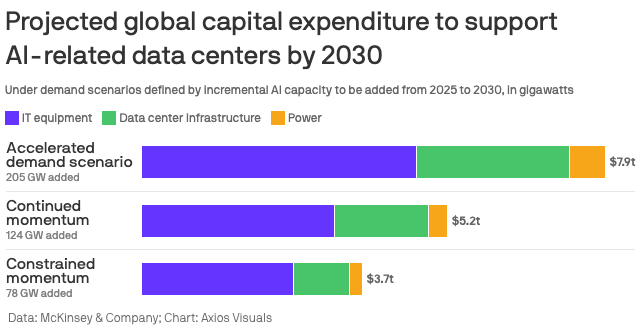
Even with rising costs, power is a small slice of what Big Tech spends on data centers.
Why it matters: This is why deep-pocketed tech companies are voluntarily offering up pledges to pay for their own power. To them, it’s just not that much money.
By the numbers: Power costs comprise up to 7.6% of the overall capital expenditures of data centers, according to McKinsey.
Reality check: The data is from a report published in April 2025, and this is a fast-moving story. McKinsey’s largest demand scenario is looking more likely than the other two lower demand scenarios.
Driving the news: Big Tech is under pressure to pay for their power prices as electricity rates rise across the country, with many communities blaming data centers.
Several Big Tech firms are slated to meet at the White House next week to sign a pledge to pay for their own electricity.
What we’re watching: Power demand from data centers could increase 50% by next year and by as much as 165% by the end of the decade, Goldman Sachs predicted earlier this month.
Friction point: Ongoing power constraints could push power prices up so high that they begin to bite into a larger share of capital costs.
Bottom line: Rising power prices hit households a lot harder than the richest companies in the world.
Share this story, and subscribe to Axios’ Future of Energy.
With investing, AI’s gain may be energy’s loss
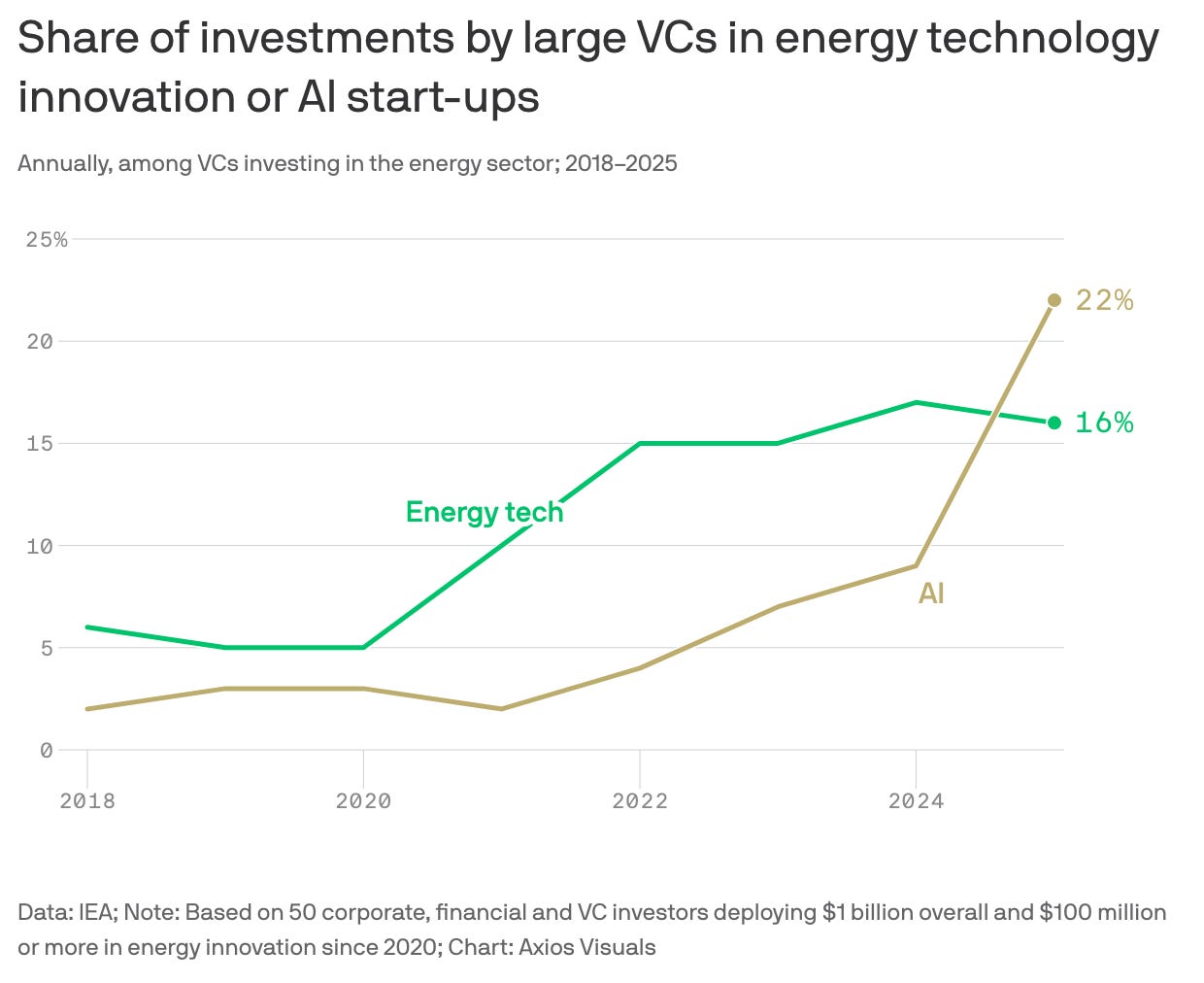
AI may be siphoning off investment dollars that once flowed to energy startups, according to a new report from the International Energy Agency.
Why it matters: The global shift is a stark, data-driven sign of the times — climate ambition is collapsing just as the AI race accelerates.
Driving the news: Some of the world’s largest venture capital funds that back energy startups have redirected at least part of their capital toward AI.
Zoom in: Across the 50 biggest funds investing in energy, specialization in energy innovation has slowed since 2022 — tracking with a rise in AI investments, the report finds.
Reality check: At the macro level, this is correlation, not clear causation. It would take a deeper dive into individual deals to determine who’s truly losing — and who’s winning — at the other’s expense.
Between the lines: There’s an irony here: The AI boom’s biggest need — energy — may be getting financially undercut by the boom itself.
Yes, but: The IEA says AI isn’t the only factor. Higher interest rates and other market pressures are also dampening energy investment.
What we’re watching: To what degree the AI surge ultimately pulls more money back into energy innovation to power its own growth.
What’s next: Major tech companies are pledging billions for clean energy, from fusion to geothermal — potentially reshaping the investment landscape yet again.
Share this story, and sign up here for Axios’ Future of Energy newsletter.
Global AI data center boom hits delays
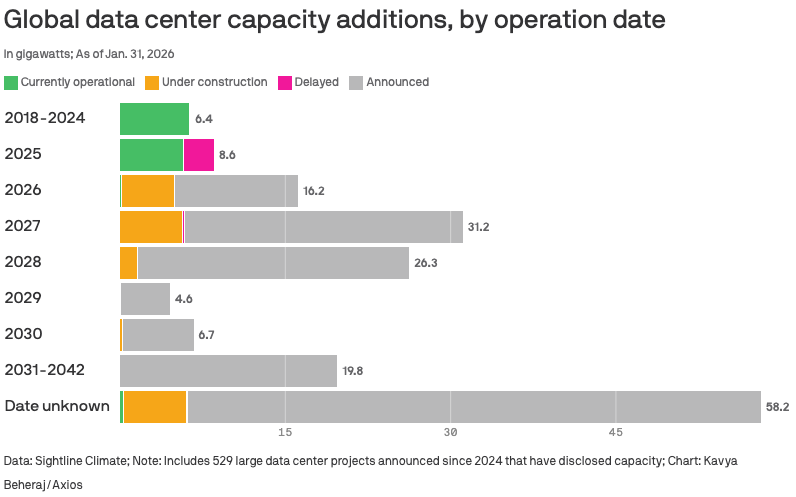
As many as half of the world’s data center projects slated to come online this year could face delays, according to a report issued Tuesday.
Why it matters: It’s a sign of mounting collisions in the AI race — from power constraints and grid equipment shortages to rising community opposition.
The big picture: As tech giants sprint to build AI infrastructure, the physical — and political — limits of the power system are starting to bite.
State of play: Up to 11 gigawatts of 2026 capacity “remains in the announced stage with no signs of construction,” per the report by Sightline Climate, a data intelligence firm.
With typical build times of 12 to 18 months, that capacity could still come online — but only with dramatic acceleration, the report states.
Yes, but: Development is still surging despite growing hurdles. Data center additions hit a record in 2025, and 2026 is on track to surpass it, Olivia Wang, a Sightline research analyst, told Axios.
By the numbers: Nearly six gigawatts came online last year, and five gigawatts are already under construction this year. (One gigawatt can power about 1 million U.S. homes.)
“While power continues to be a constraint, developers that locked in power and equipment contracts early are rapidly bringing capacity online,” the report says.
Driving the news: With midterm elections heating up, communities are growing restless over rising power prices — which many blame on data centers that increasingly require city-scale electricity.
Zoom in: Sightline has tracked more than 10 new moratorium proposals in the past month alone in U.S. states.
This includes New York, Michigan, Virginia and Oklahoma, Wang says.
“We expect this trend to continue and meaningfully increase the risk of projects being delayed, withdrawn, and ultimately canceled,” Wang wrote.
The firm is tracking nine canceled projects in its database, so for now, most are facing delays, not outright cancellations.
Flashback: More than one-quarter of the 110 data center projects that were slated to come online last year were delayed.
What we’re watching: Whether high-profile cancellations rise along with the wave of moratorium efforts.
Share this story, and sign up here for Axios’ Future of Energy newsletter.
Word cloud darkens San Diego solar confab
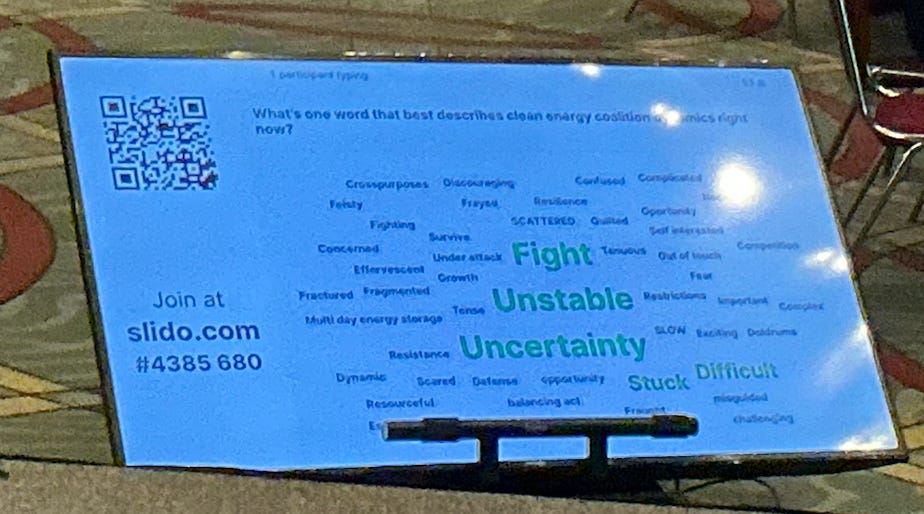

😬 What's one word that best describes clean energy coalition dynamics right now?
Fight
Unstable
Uncertainty
Stuck
Difficult
Ouch. These were actual -- live, in the moment -- words dozens of participants attending Intersolar’s recent San Diego confab put up into a spontaneous Slido word cloud we hosted at the end of our keynote conversation.
Our panelists, seeing this in real time, sought to balance out the difficult candor with perseverance when I asked them for their one words, including committed, exciting, resolve and hope.