


Come for the unique news, stay for the old/new energy contrast in my hometown.
Emissions will keep falling despite Trump’s climate rollback
President Trump is trying to pull the rug out from under federal climate regulation. But the U.S. economy may no longer be standing on it.
Why it matters: The energy transition is well underway and is unlikely to be reversed by Thursday’s historic move.
The big picture: America’s emissions are projected to decline substantially even if major climate regulations are repealed, driven by falling renewable energy prices and cleaner natural gas outcompeting dirtier coal.
Driving the news: The Environmental Protection Agency last week overturned the 2009 “endangerment finding,” which determined that greenhouse gases threaten public health and welfare.
The finding sets the foundation for federal regulation of climate pollution under the Clean Air Act.
Issued under President Obama, it reflects the global scientific consensus that greenhouse gases are warming the planet.
Between the lines: The repeal is legally and symbolically seismic. Its real-world impact may be more muted.
It would likely slow emissions cuts — but not reverse them, according to modeling by the Rhodium Group, a New York-based research firm.
By the numbers: The firm projects that without big EPA rules underpinned by the finding, U.S. emissions in 2035 would be 26-35% below 2005 levels.
If the rules were intact? A steeper decline of 32-44%.
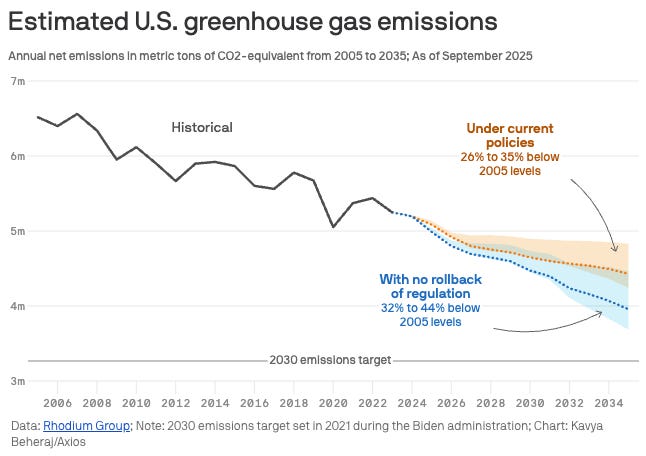
Reality check: Neither path comes close to what scientists say is needed to avoid the worst climate impacts.
In its final weeks, the Biden administration set a target of cutting emissions at least 61% by 2035 — roughly aligned with the Paris Agreement’s goal of limiting warming to well below 2°C above preindustrial levels.
Flashback: After years of regulatory whiplash, the finding itself has directly reduced little, if any, emissions since 2009.
Obama-era rules for vehicles, power plants and oil and gas were delayed, challenged or repealed in Trump’s first term.
Then-President Biden restarted the process. Trump has now begun unwinding things again.
What they’re saying: “Although the environmental community has viewed the endangerment finding as the holy grail, it has done very little to reduce greenhouse gas emissions,” said Jeff Holmstead, a former top EPA official who’s now a partner at the lobbying firm Bracewell, which represents a range of corporate clients.
Yes, but: The finding’s influence likely extended beyond formal rules.
It signaled that federal climate regulation was coming — shaping corporate decisions in ways that are hard to quantify.
“As an energy system modeler, I can only do what’s on my spreadsheet. And there’s not something that says, ‘turn on U.S. leadership on climate,’ “ said Ben King, a director at Rhodium who was involved in the analysis.
Zoom out: Thursday’s action marks the most aggressive move yet in nearly two decades of climate policy ping-pong.
And it’s reigniting debate about the limits of tackling a decades-long problem through these regulatory swings.
“It does point to the risk of basing sweeping and really important policy on fragile foundations,” said Josh Freed, senior vice president for the climate and energy program at the center-left think tank Third Way.
What we’re watching: Inevitable lawsuits will likely take years to make it to their final destination of the Supreme Court.
“More importantly, the primary drivers for clean energy generation right now are commercial,” said David Goldwyn, president of consulting firm Goldwyn Global Strategies.
“There is market demand for fast, clean power, especially for data centers, which face formidable license to operate issues.”
The bottom line: Decades of state and federal policy, plus market shifts, have pushed the economy toward cleaner energy. So far, Trump’s rollback isn’t enough to turn it around.
Axios’ Ben Geman contributed reporting.
Exclusive: Power broker in AI boom draws takeover interest

An obscure, two-year-old company has emerged as a quiet power broker — literally — in the AI boom.
Why it matters: Houston-based Cloverleaf Infrastructure is lining up massive deals securing land and city-scale electricity to fuel data centers — the single biggest bottleneck in AI expansion.
Driving the news: The company — founded in February 2024 by three energy veterans — is being courted by multiple potential buyers, according to a person familiar with the matter who spoke on condition of anonymity.
A decision could come within weeks.
Brian Janous, co-founder of Cloverleaf, declined to comment on acquisition discussions.
The big picture: Cloverleaf’s rapid rise — and takeover interest — underscores the frenzy to lock down power as AI demand explodes.
Catch up fast: Natural gas is fast becoming a default choice to fuel the AI boom. Janous, who is also the firm’s chief commercial officer, says Cloverleaf is proving another way by pooling existing clean energy.
“A lot of people default to the easy thing,” Janous said in a recent interview in his office in downtown Seattle. “Doing this the more sustainable, lower-carbon way is actually better, faster and cheaper.”
Follow the money: Cloverleaf has raised roughly $300 million, announced in July 2024.
Backers include NGP Energy Capital Management and Sandbrook Capital, alongside investments from company leadership.
What they’re saying: “I see Cloverleaf as an example of data center development done right,” said Michael Thomas, founder and CEO of Cleanview, a market intelligence platform.
“They are finding creative ways to build data centers and bring their own capacity, but they’re doing it almost entirely with clean energy storage and flexible curtailment.”
How it works: Cloverleaf’s thesis: America’s regional grids already have stranded or underused capacity. The challenge is coordination.
“We have a lot of leverage to orchestrate solutions that are, right now, sitting in silos,” said Janous. “It’s more a business problem than a technical problem.”
Zoom in: Most of that unrealized electric capacity is coming from renewable energy, but Janous said some of their projects have made use of natural gas plants that only run during peak demand.
“We don’t want to hitch our sites on the need to run a lot of new fossil fuels,” Janous said.
The other side: Many developers are moving in the opposite direction, installing on-site natural gas because it’s dispatchable and reliable.
In parts of the Mid-Atlantic and Midwest — America’s AI hotbed — gas is increasingly the default for AI facilities.
By the numbers: Cloverleaf is pursuing projects totaling 10 to 15 gigawatts of peak power capacity — roughly 10 to 15 times Seattle’s peak electricity demand.
“That’s a very big bite for anyone,” Janous said.
Projects have included large-scale developments in Wisconsin and Georgia.
The intrigue: Janous was Microsoft’s first energy hire 15 years ago.
Co-founders David Berry and Jonathan Abebe bring decades of electricity development experience across U.S. power markets.
Despite managing multibillion-dollar prospects, Cloverleaf is lean — about 30 employees across its Houston headquarters and Seattle office.
In Seattle, the team works out of a shared high-rise space. Janous showed up to our interview in jeans and a Seahawks jersey ahead of the Super Bowl.
Reality check: Community pushback is rising as developers propose city-sized data centers. Janous acknowledges that opposition could slow growth.
“We’re literally on the ground every single week talking with locals,” he said.
Some communities, he added, prefer data centers to factories because they don’t drive population growth.
Yes, but: It backed out of at least one project in Wisconsin after local opposition intensified.
“I definitely think the opposition is increasing,” said Janous, who added the company still plans to pursue a project in that region. “We’re not so Pollyannish that we believe everyone is going to be super excited we’re there.”
What we’re watching: Whether Cloverleaf sells — and whether its clean-power-first model wins in this AI arms race.
Read this full story in Axios.
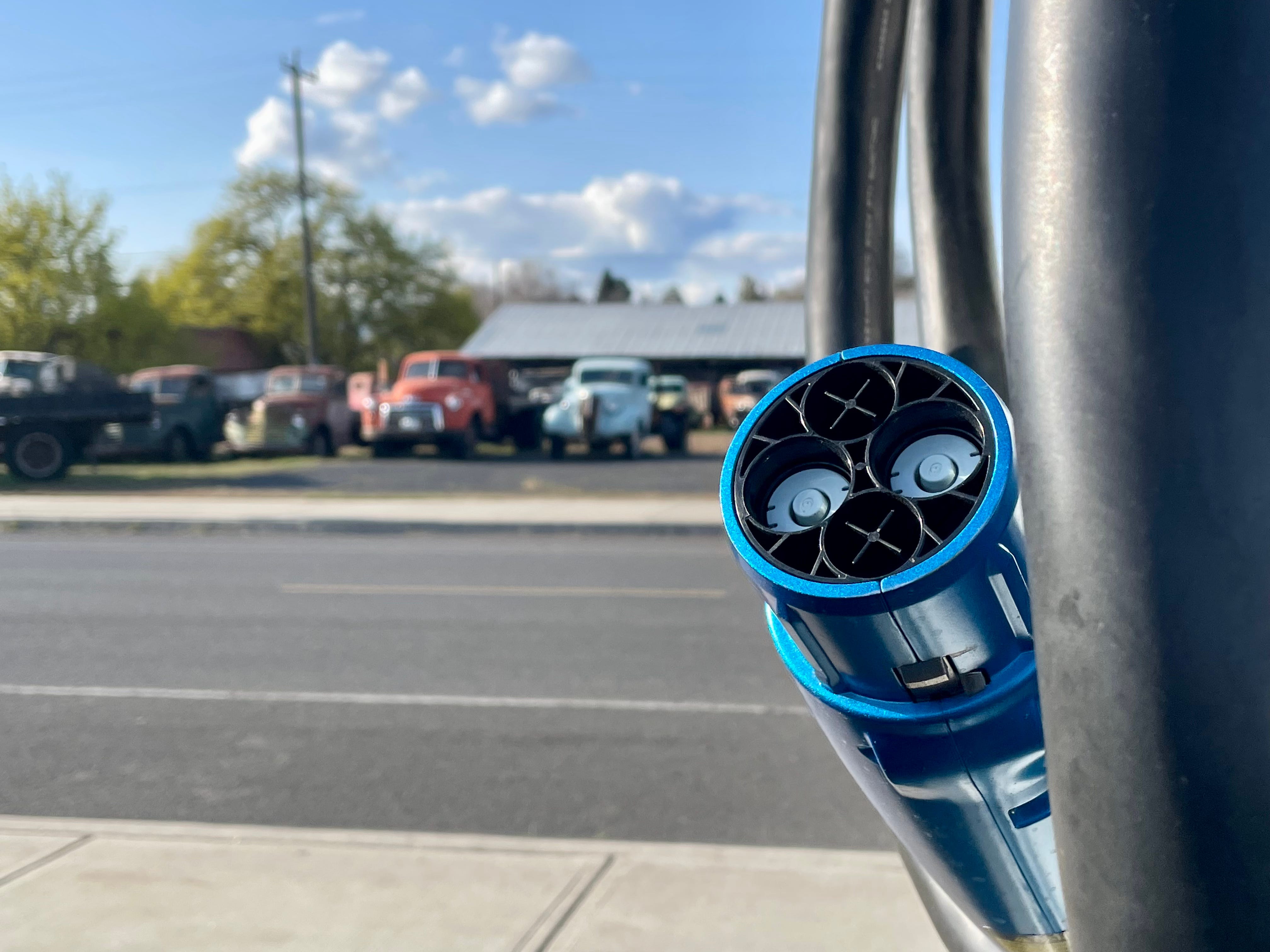
This is a charging station contrasted with old trucks in my tiny hometown of Sprague, WA. I was visiting home last weekend and find the contrast between old and new quite striking in rural parts of our country.