Come for the news spanning our humanity and energy, stay for the powerful art shots at the end.
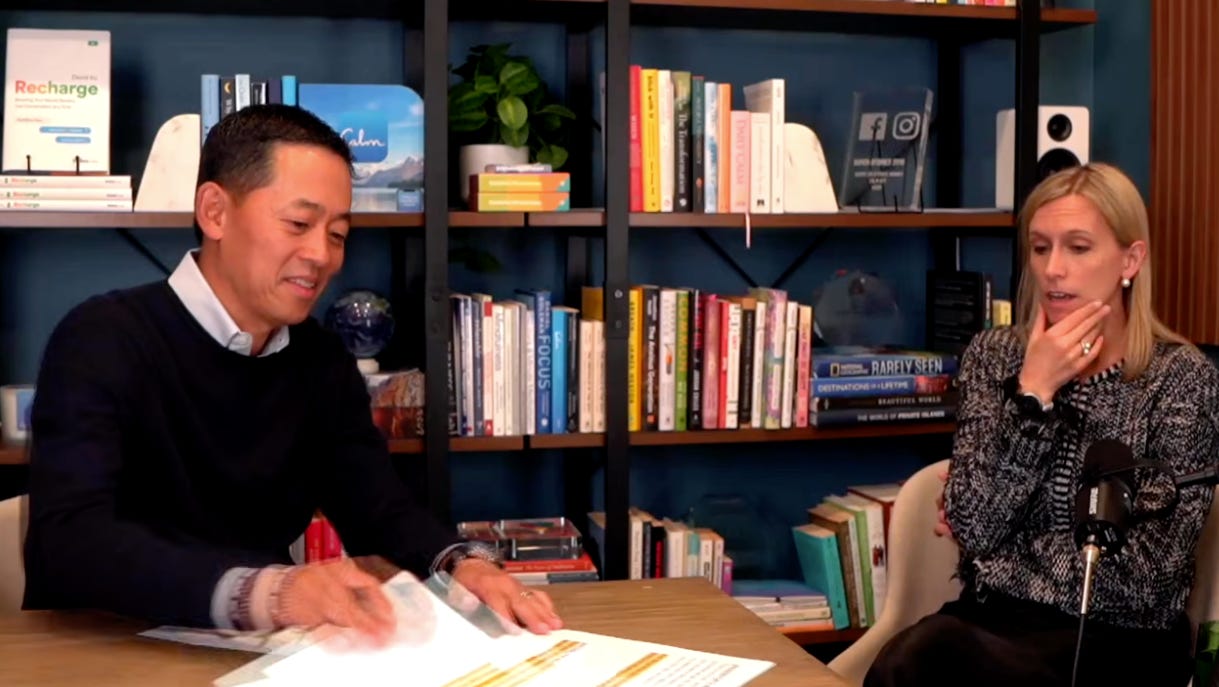
🎙️ I joined the Recharge podcast with David Ko, former Calm CEO, to talk about my journey as a reporter navigating AI and more. Listen wherever you get your podcasts, or watch the YouTube versions here and here! (It’s a two-parter).
🙏 I also interviewed David for a recent Axios Finish Line column, included below.
Former Calm CEO: How to retain your humanity and embrace AI
A just-departed executive at one of the world’s most influential wellness companies is giving us three pieces of advice for preserving our humanity in the age of AI.
The big picture: David Ko, who was CEO of the app Calm for the last four years, recently stepped down to pursue a new, undisclosed path focused on guardrails for kids using AI. He’s exceptionally candid about his exit.
“If we didn’t have AI, I would not leave,” Ko said in an April interview at the Palo Alto headquarters of Calm, just a couple weeks after his announced departure. “If we weren’t having AI conversations today, I’d still be the CEO of Calm.”
Calm, founded in 2012, is a mental wellness app that has more than 180 million downloads.
Zoom out: Ko sees AI moving faster than social media, with potentially similar risks for young people. As a father of two daughters — a teen and a college student — that urgency is driving his pivot.
“Let’s not make that same mistake twice with something that’s moving twice as fast,” said Ko, who will continue advising the board of Calm.
Here’s Ko’s advice for using AI mindfully:
1. Protect your critical thinking.
Do not accept the initial output from an AI model. Two reasons: you’ll get better results, and you’ll protect your own mind, Ko said.
Referring to his younger daughter‘s AI use, Ko added: “She’ll go a few rounds and push back on the AI tool.”
Zoom in: Even if AI delivers instant answers, kids still need to learn how to think their way to them.
Ko said critical thinking should be treated like physical education, good for its own sake. “Isn’t it good for children to exercise? Of course it is. So why is it good to give kids all the answers?”
2. Be intentional with your “found time.”
AI is making people more efficient at a rapid pace, which makes the time savings more visible.
Sometimes you should use that time to do more work, but it shouldn’t be the subconscious, reflexive answer.
“If you find yourself saving time, then find yourself doing things that give you joy,” Ko said.
3. Skip the big talk — go small.
“I find often that people try to have the one heavy conversation” with kids, Ko said. “I find that rarely works.”
Instead, he suggests frequent, low-stakes conversations — often sparked by what kids are already seeing, like a TikTok about AI.
Reality check: For fellow tech CEOs working in and around AI, he suggests applying his “ultimate litmus test”:
“Are you comfortable with your children using the products that you’re building?” Ko said. If you’re not, “maybe you should rethink whether or not we should be working on some of those products.”
Flashback: Ko is a longtime consumer tech and health care executive who helped build one of the first social gaming giants, Zynga, and later ran a major digital health company owned by UnitedHealth Group.
What’s next: In his next chapter, Ko is working with former Democratic Rep. Patrick Kennedy, who spearheaded major mental health legislation that passed Congress in 2008 and later founded The Kennedy Forum, a nonprofit mental health organization.
The bottom line: “How can we be more bipartisan in thinking about this across the country,” Ko said. “And how could it be used as something we think about more globally going forward?”
Share this article from Axios here.
Exclusive: Clean energy deals on track for “biggest year ever”
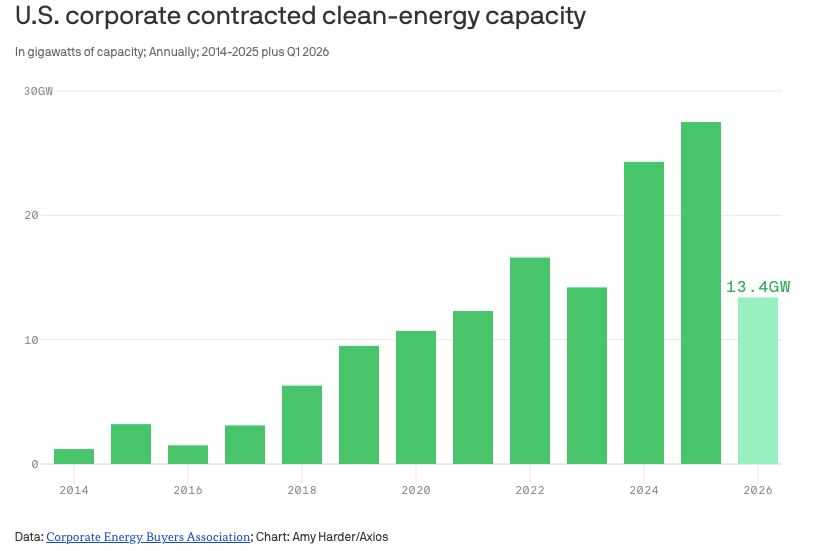
Corporations are poised to buy more clean energy this year than ever before, driven by the AI boom and a rush to secure expiring tax credits, according to a new report shared exclusively with Axios.
Why it matters: The surge underscores the enduring influence of corporate demand on the clean energy market — and the resilience of cleantech investment even after President Trump rolled back federal support.
Driving the news: Companies contracted 13.4 gigawatts of clean energy capacity in the first quarter of 2026 alone, according to the Corporate Energy Buyers Association’s annual report.
That exceeds the total contracted during all of 2021.
“It’s hard to imagine this won’t be our biggest year ever,” Rich Powell, CEO of the association, told Axios ahead of the report’s release Tuesday at the group’s annual gathering in Seattle.
Read the full story on Axios.com.
Fusion energy poised for simpler U.S. review
Fusion energy — tapping the power of the stars — is on the cusp of getting new federal rules.
Why it matters: Regulators increasingly view fusion as fundamentally safer than nuclear fission, helping to pave the way for a substantially simpler permitting process than the one faced by conventional nuclear plants.
Driving the news: The federal Nuclear Regulatory Commission is closing the public comment period on the proposed rule on Wednesday, with a final regulation expected as soon as this fall.
The big picture: Fusion electricity doesn’t yet exist in reality, but industry leaders see this regulatory move as fundamental to commercializing the technology in the United States in the next decade.
“This is a big deal — we’ve been working toward this for a long time,” said Andrew Holland, CEO of the Fusion Industry Association.
Read the full story in Axios.
Discord: Climate exhibit opening in Vancouver, BC
A new, sweeping climate change exhibit just opened at the Vancouver Art Gallery in the coastal British Columbian city.
The intrigue: Two exhibits that stuck with me during a visit last weekend:
That video above is from an art installation by Jean Shin, called “Huddled Masses.” We’ve all been there with the leftover, outdated cords we don’t know what to do with.
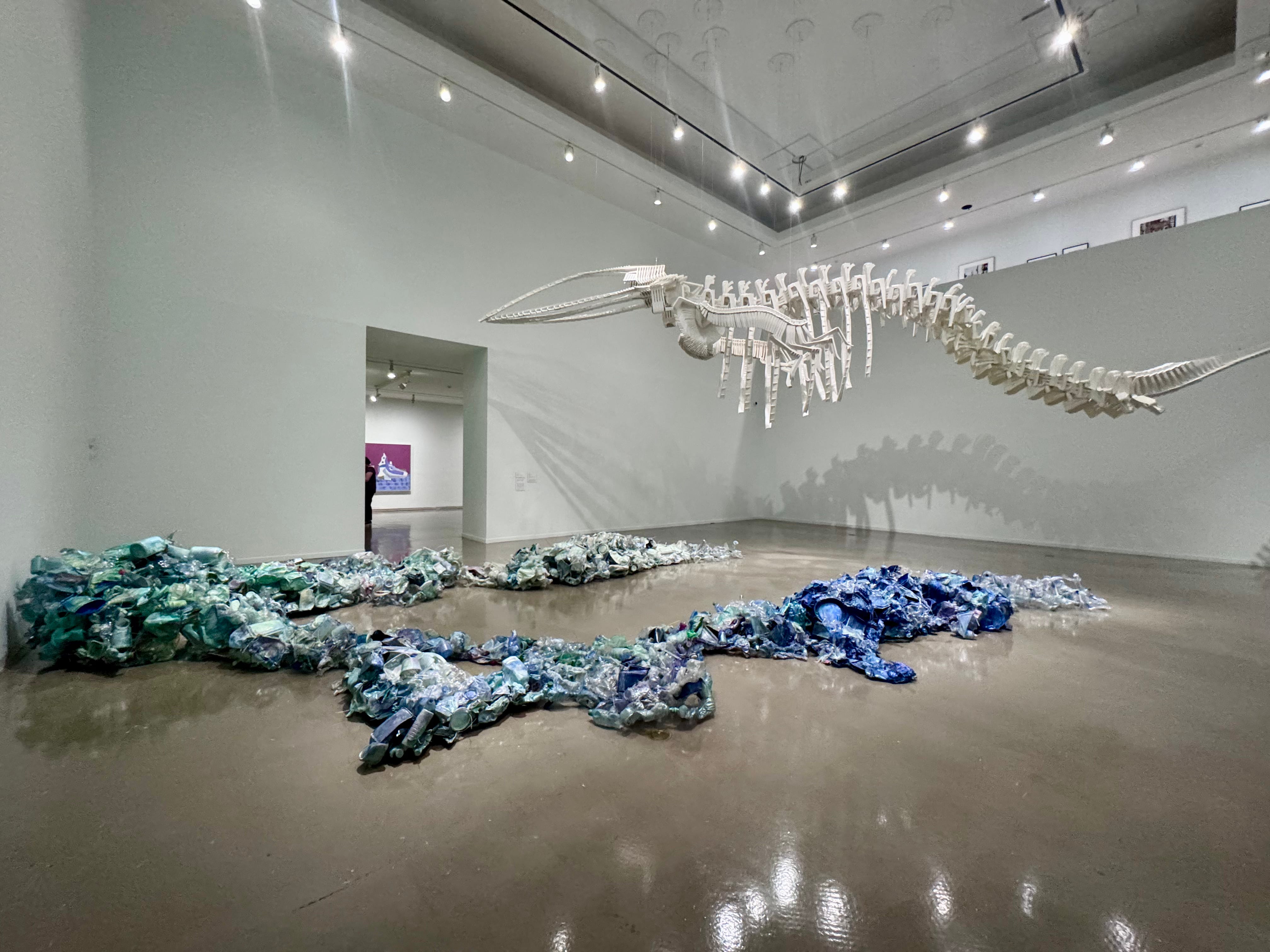
The exhibit below includes plastic bottles shaped like the Great Pacific Garbage Patch, by Liz Larner, and the whale skeleton hanging from the ceiling is made out of plastic patio chairs, by Brian Jungen.
Check it out if you’re in the area.