
Here’s my last few weeks of journalism! Stay until the end for a festive London photo op.
AI’s energy gusher
The age of AI is ushering in the golden age of American energy.
Why it matters: Long prized for being boring — cheap, reliable, predictable — American power is exploding with new growth, new wild ideas and new sci-fi level possibilities.
It’s a massive growth engine for the U.S. economy and brimming with once-unimaginable investment and experimentation.
The tech and energy industries — and perceptions of them — are shifting fast and often in counterintuitive ways.
The big picture: AI sucks up most of the media and public attention. But our energy landscape is also changing at an unprecedented clip to power that AI.
Reality check: As with past energy golden ages — shale oil and gas, electrification, the rise of cars — this one carries its own underbelly: data center backlash, higher power prices and new equity concerns.
How it works: The AI boom is shifting the tectonic plates of our stubborn energy systems. One tectonic plate has been squarely in our face (and our power bills) this past year. Three others are also sliding into place.
Let’s break them down:
A data center land rush is pushing up electricity prices, igniting NIMBY fights and straining grid reliability. The latest sign of stress: The NAACP is holding an event this week called “Stop Dirty Data“ to highlight its concerns.
Skyrocketing power demand is boosting once-too-expensive clean-energy technologies — from advanced nuclear to carbon capture — by giving them massive prospective customers such as Google and Microsoft willing to pay top dollar.
AI itself could accelerate cleantech breakthroughs, including long-promised dreams like fusion. It’s already helping with geothermal discoveries.
AI is also boosting oil and gas, improving subsurface mapping and squeezing more fuel out of existing fields.
Read the full story in Axios here.
AI could unleash a trillion more barrels of oil
AI is emerging as the oil industry’s next big unlock by boosting reserves and supercharging efficiency.
Why it matters: This could stabilize oil and gas prices over the long term, but it’s also raising questions about the climate impacts of such trends.
“The sky is the limit in terms of the production,” Mike Sommers, head of the American Petroleum Institute, told Axios. “The days of predicting peak oil are long gone.”
Driving the news: AI could “unlock an extra trillion barrels of oil,” Wood Mackenzie wrote in a recent report.
The consultancy says its new proprietary AI tech is allowing companies to better identify where they “can wring substantially more oil out of producing reservoirs.”
In layperson’s terms: AI is helping squeeze more juice out of the same orange.
What they’re saying: “That’s a TRILLION ADDITIONAL barrels of oil [that] would not otherwise be possible. 🤯,” wrote climate activist Holly Alpine on LinkedIn.
Read the full story in Axios.
China blowing past world on renewables and EVs
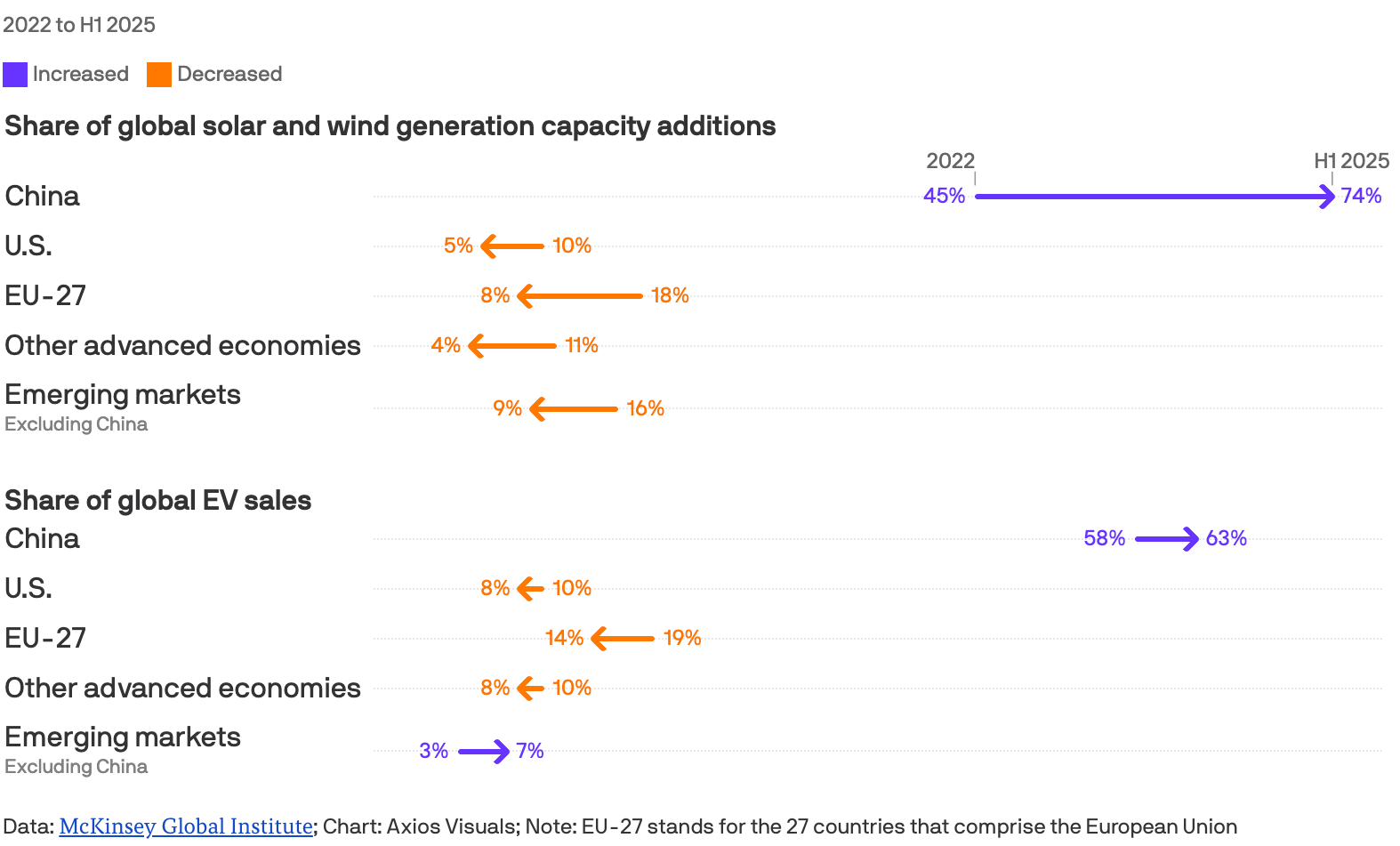
Read the story in Axios.
Where Bill Gates draws the line on dimming the sun
Bill Gates says he would support deploying artificial cooling technologies to lower global temperatures — but only if the planet hits so-called climate tipping points.
Why it matters: The Microsoft co-founder and philanthropist is a major funder of research into this controversial technology, and his comments in a recent interview with Axios are among his most expansive yet.
Activity by startups has sparked a wave of media attention to the tech, which is known as geoengineering. Coverage includes The New Yorker, The Atlantic and Politico magazine during November alone.
The big picture: Solar radiation management — reflecting more of the sun’s energy back into space — is a subset of geoengineering that’s shifting from fringe science and conspiracy theory into mainstream policy debate.
The idea could help blunt extreme weather, but its risks remain uncertain and likely significant.
How it works: Solar radiation management, or solar geoengineering, aims to cool the planet by reflecting sunlight.
The most-discussed method involves injecting sulfuric-acid particles into the upper atmosphere, mimicking the cooling effect of volcanic eruptions.
Driving the news: Gates’ comments, made during an interview last month at Caltech, are significant because he makes a distinction between what’s become a more common position — supporting research into geoengineering — versus actually deploying it.
Zoom out: In the interview, Gates said the world is largely on track to avoid the worst climate impacts thanks to rising clean-energy deployment.
But he emphasized there’s still an outlier chance of especially dire consequences driven in part by tipping points — scenarios in which warming triggers reinforcing feedbacks, or secondary effects, which accelerate climate change.
You “would then need to reach for some other type of intervention,” Gates said.
When asked whether that meant geoengineering — and whether he would support its deployment in such a scenario — Gates replied: “Yes, I’ve been a funder of trying to understand geoengineering.”
Read the full article in Axios.
The unintended consequences of pipeline fights
The latest episode — and last for season 1! — of the Shocked podcast with U Chicago tackles the unintended consequences of trying to stop fossil-fuel infrastructure.
Listen here + read my coverage of the episode in Axios.

Holiday in Covent Garden!