


The climate agenda’s fall from grace over the past year has been stunning — in speed, scale and scope.
Why it matters: Whether this collapse in climate-change ambition proves permanent or temporary will shape the planet — which is still warming in unprecedented ways — and trillions of dollars in global energy investment.
Driving the news: President Trump last week announced that he’s withdrawing from the world’s flagship climate treaty that’s been in place for more than 30 years, making the U.S. the only country not to be part of it.
“There’s no hand-waving about how ‘We want to cooperate on climate,’” oil historian and S&P Global vice chairman Dan Yergin said in an interview. “It’s, ‘We’re slamming the door on that issue.’”
“We’ve gone from over-indexing it to zero-indexing it.”
The big picture: The last 30 years of global history “was an exceptionally unusual period,” said Nat Keohane, president of the nonprofit Center for Climate and Energy Solutions.
After the Cold War, countries — led by the U.S. — bonded together and created global institutions.
“Climate policy was facilitated by multilateralism, globalization and the sense nations had a common agenda far more than the world we live in right now,” Yergin said.
Catch up fast: The last year has seen an epic reversal that spread quickly from governments to boardrooms to pop culture.
Read the full Axios story here.
What history says about today’s AI power surge
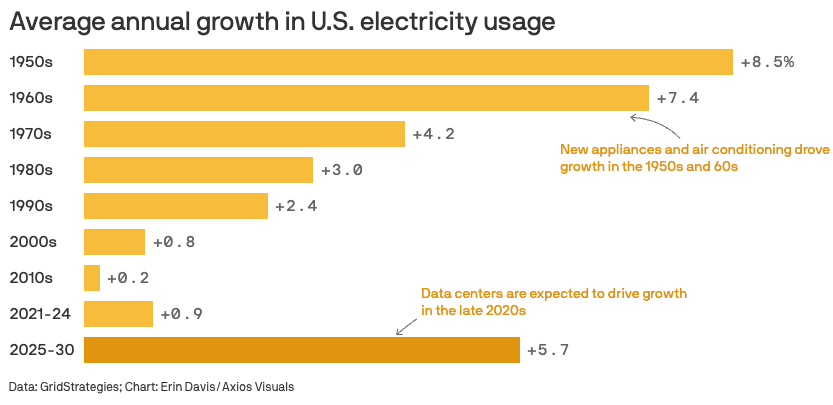
This might be our first AI race, but it’s not America’s first power boom.
Why it matters: The latest boom in power is scrambling our communities, politics and power bills, with Big Tech companies making promises seeking to ease said scramble.
The big picture: The U.S. has been able to meet soaring electricity demand in decades past at even higher growth rates than what experts are predicting now.
Yes, but: “One must keep in mind that the magnitude of current load is far above that of the ‘70s and ‘80s,” said power expert and consultant Rob Gramlich, president of consulting firm Grid Strategies LLC.
The magnitude is “relatively large and possibly unprecedented,” Gramlich said by email.
Zoom out: “Every technology that has required a major infrastructure expansion has involved precisely the kinds of questions that we’re facing here,” Microsoft President Brad Smith told Axios’ Ina Fried about his company’s recently stated pledge to not burden locals with its data centers.
“Private companies cannot solve all the issues by themselves, but they can make it easier when they take a high road,” Smith said.
How much power prices are really rising
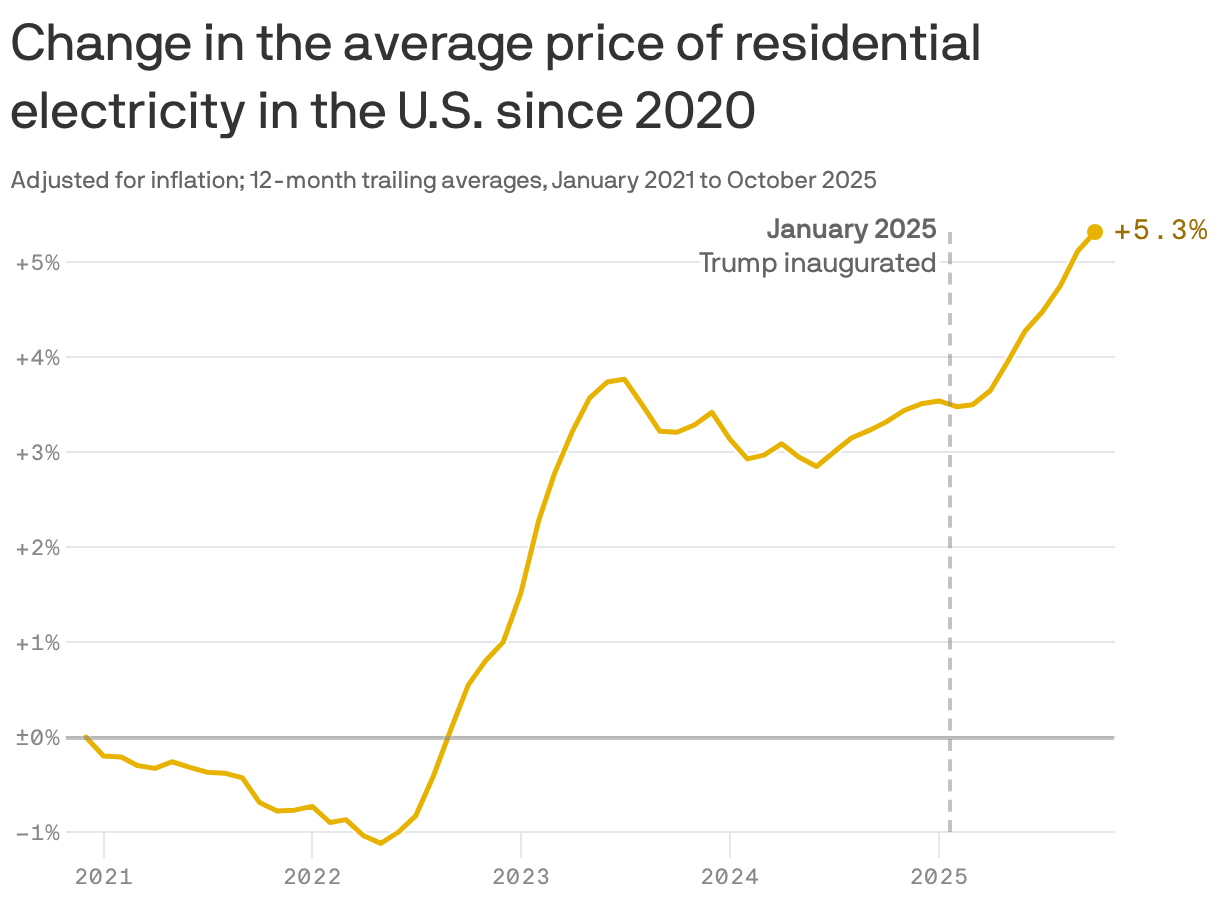
Yes, national average power prices have risen, but no, not as much as President Trump said.
Why it matters: With plug prices the political term du jour this election year, sifting through arcane power price data will be important to find the facts.
Driving the news: In a Truth Social post this week, Trump claimed household utility bills rose “over 30%” under President Biden.
Where it stands: National electricity prices rose 4.7%, when adjusted for inflation, during Biden’s term, with a noticeable uptick in 2022, alongside the early boom in AI.
Between the lines: Without adjusting for inflation, that 4.7% figure rises to 25.8%, far closer to Trump’s claim.
Zoom in: Some states — particularly those in the Mid-Atlantic where a lot of data centers are being built — are seeing higher price spikes than the national average.
Reality check: Similar to gasoline prices, electricity prices go up and down for a variety of complex reasons, often not correlating much at all with the sitting president.
What we’re watching: Prices are continuing to rise under Trump, including in the nation’s capital.
The Energy Department didn’t immediately respond to a request for comment.
Share this Axios story.
Here’s what kind of energy is fueling AI
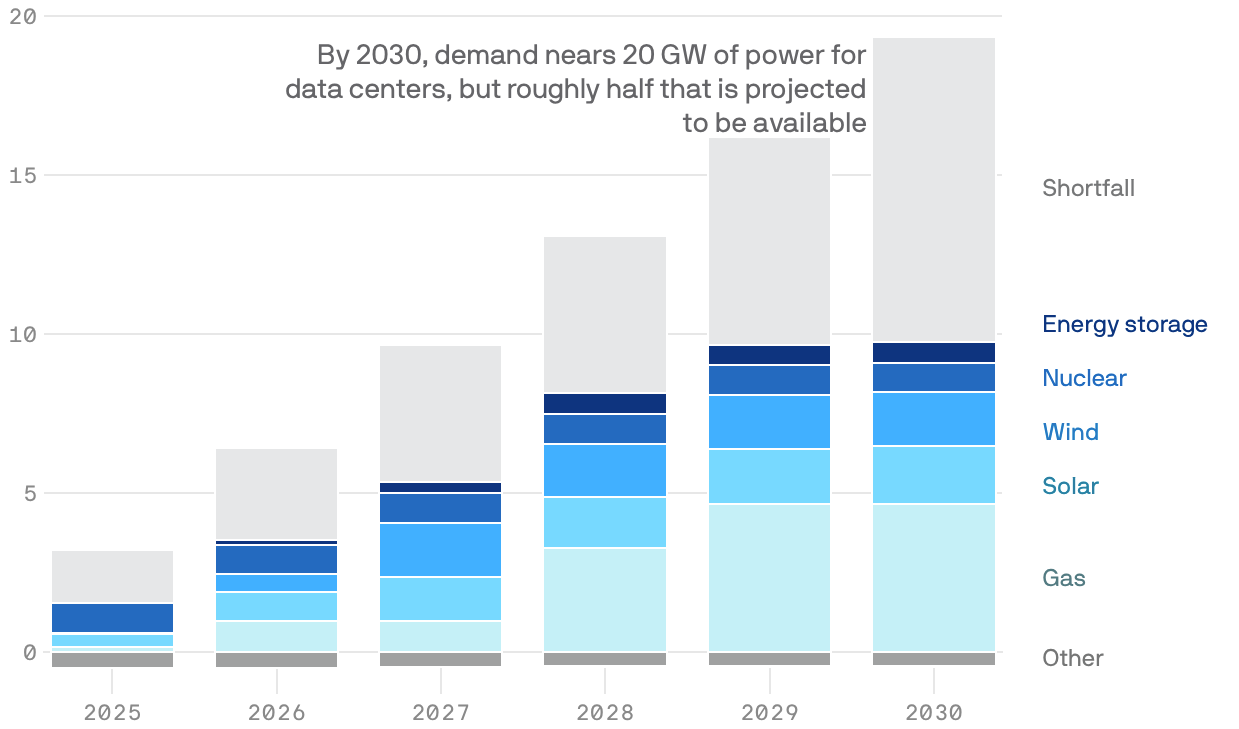
Natural gas is filling the biggest role fueling electricity for data centers in the Mid-Atlantic and Midwest — the country’s AI hotbed — but the region is still staring down a huge shortfall in power.
Why it matters: Society faces the risk of spiking power prices or — worse — no power at all if this gap isn’t resolved by either adding more power or fewer data centers.
How it works: The chart above illustrates what’s known as the effective load carrying capability, or ELCC.
This is a method that grid operators use to measure how much an energy resource — such as renewables or natural gas — can reliably contribute to meeting power demand at times when the grid is most at risk of shortages.
As wind and solar grow on the grid, ELCC provides a more precise way to assess how much dependable capacity they actually add, accounting for their variability.
That’s unlike traditional resources such as natural gas, which can generally be dispatched on demand, according to a spokesperson for BloombergNEF.
Go deeper in Axios.
🏃♀️ Art on the run 🙃

I snapped this photo while on recent pre-dawn run. It looks kind of like art, but what is it really?